
Studio Brief
SNAP in Transition: How New Federal Rules Could Reshape Food Assistance Across the U.S.
Cost-sharing shifts, payment error penalties, and shutdown-era uncertainty are rewriting the operating model for the nation's largest nutrition program.
In Brief
SNAP now serves more than 42 million Americans, but proposed federal changes could move significant costs to states and counties. The new rules tie funding to payment error rates and arrive as shutdown-era volatility strains benefit delivery.
Key Signals
- Administrative costs shift in 2026. States move from a 50/50 split to 75% responsibility for administrative expenses.
- Benefit funding becomes conditional in 2027. States start paying a share of benefit costs based on payment error rates.
- Accuracy becomes fiscal policy. Investments in QA, automation, and error reduction will directly influence state exposure.
Context
The Supplemental Nutrition Assistance Program (SNAP), also known as the Food Stamp Program, provides nutrition assistance to more than 42 million Americans nationwide, or 1 in 8 individuals (USDA Economic Research Service (ERS)). It remains one of the federal government’s most effective anti-poverty tools, ensuring low-income households can afford groceries and maintain food security. Proposed changes in the “One Big Beautiful Bill Act” (H.R. 1) would alter how SNAP is funded and administered (U.S. Congress, H.R. 1 (119th Congress)). Combined with ongoing federal budget disputes and government shutdown uncertainty, the program is entering a pivotal re-design moment. The next two years will determine whether states can keep coverage stable while absorbing new fiscal risk.
A Shift in Administrative Cost-Sharing
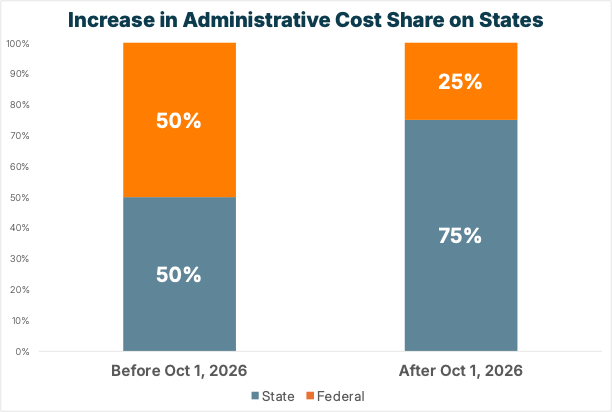
SNAP is administered jointly by the federal government and the states, with administrative costs historically split 50/50 (Congressional Research Service (CRS), R42505). Beginning October 1, 2026, states will cover 75% of administrative costs while the federal share drops to 25% (Congressional Research Service (CRS), R42505). Supporters argue stricter work requirements could lower enrollment and reduce workload, but most states already route non-federal costs to counties, meaning local budgets will feel the pressure first. Rural departments of social services are especially exposed because staffing shortages make it hard to absorb new administrative duties. The shift creates an immediate fiscal shock even before benefit funding changes begin.
Changes to Benefit Funding
Since SNAP’s inception, the federal government has paid 100% of benefit costs, but that guarantee ends on October 1, 2027 (Congressional Research Service (CRS), R42505). States will begin covering a portion of benefit dollars based on their payment error rates, tying fiscal exposure to administrative accuracy. Error rates are calculated through the USDA Quality Control process and usually reflect unintentional mistakes, not fraud (USDA Food and Nutrition Service (FNS), SNAP Quality Control). The implementation date is delayed until FY2029 or FY2030 for states whose error rate multiplied by 1.5 meets or exceeds 20% in FY2025 or FY2026. That delay gives high-error states more time but does not erase the eventual cost shift.
Projected Payment Error Rate Tiers
The tiers below show which states fall into each match bracket based on current error rates, illustrating how quickly cost exposure escalates as accuracy declines. Each snapshot lists example states inside that tier, and the 10%+ tier includes a longer list because more states fall into that bracket. These thresholds are set in H.R. 1 and reflect the penalty structure states will face if rates remain unchanged. The tables are grouped to make it easier to compare which states will face new state match requirements.
States under the 6% error threshold would owe no state match for benefit costs.
| State | PER (%) |
|---|---|
| Nevada | 5.94 |
| Utah | 5.74 |
| Nebraska | 5.50 |
| Vermont | 5.13 |
| Wyoming | 5.12 |
| Wisconsin | 4.47 |
| Idaho | 3.59 |
| Virgin Islands | 3.54 |
| South Dakota | 3.28 |
States between 6% and 8% would pay a 5% match for benefit costs.
| State | PER (%) |
|---|---|
| North Dakota | 7.91 |
| New Hampshire | 7.57 |
| Hawaii | 6.68 |
| Louisiana | 6.62 |
| Iowa | 6.14 |
| Washington | 6.06 |
States between 8% and 10% would pay a 10% match for benefit costs.
| State | PER (%) |
|---|---|
| Kansas | 9.98 |
| Colorado | 9.87 |
| Guam | 9.72 |
| Arkansas | 9.58 |
| Michigan | 9.53 |
| Indiana | 9.52 |
| Tennessee | 9.47 |
| West Virginia | 9.43 |
| Missouri | 9.42 |
| South Carolina | 9.25 |
| Kentucky | 9.11 |
| Ohio | 9.01 |
| Minnesota | 8.98 |
| Montana | 8.89 |
| Arizona | 8.84 |
| Alabama | 8.32 |
| Texas | 8.32 |
States at or above 10% face a 15% match, with Alaska and DC at the highest rates.
| State | PER (%) |
|---|---|
| Alaska | 24.66 |
| District of Columbia | 17.38 |
| Georgia | 15.65 |
| Florida | 15.13 |
| New Mexico | 14.61 |
| New Jersey | 14.33 |
| Massachusetts | 14.10 |
| New York | 14.09 |
| Oregon | 14.06 |
| Maryland | 13.84 |
| Delaware | 12.37 |
| Rhode Island | 12.29 |
| Illinois | 11.56 |
| Virginia | 11.50 |
| California | 10.98 |
| Oklahoma | 10.87 |
| Pennsylvania | 10.76 |
| Mississippi | 10.69 |
| Maine | 10.26 |
| Connecticut | 10.25 |
| North Carolina | 10.21 |
Can States Reduce Their Financial Exposure?
States cannot arbitrarily restrict eligibility because federal law sets uniform standards (U.S. Code, 7 U.S.C. § 2014). The allowable exceptions are narrow, such as exclusions tied to drug-related felonies, limits on broad-based categorical eligibility, or child support compliance rules (USDA Food and Nutrition Service (FNS), SNAP State Options Report (15th ed.)). That leaves error reduction as the most viable financial strategy. States can invest in QA staffing, automation, and data-matching improvements to reduce mistakes. Root-cause analysis of recurring errors becomes a budget strategy as much as a compliance exercise.
Human and Economic Implications
Even temporary disruptions in SNAP benefits can push households into food insecurity. If state and county offices absorb higher administrative costs without new funding, processing delays and backlogs could grow, increasing demand on food banks and community pantries (Axios). SNAP participation is also linked to lower theft-related crime near grocery stores, which means benefit volatility can spill into public safety concerns (Xu, 2025). Reductions or delays in benefits can intensify hardship and worsen health outcomes tied to poor nutrition. The downstream consequences land fastest in rural and low-income regions with fewer safety-net buffers.
Government Shutdown Stress Test
As of October 1, 2025, the federal government shut down after Congress failed to pass a budget for the new fiscal year (National Conference of State Legislatures (NCSL)). In early November, USDA used roughly $4.6 billion from its emergency reserve to cover about half of SNAP’s monthly costs, instead of paying full benefits (Center on Budget and Policy Priorities (CBPP)). The decision forced partial payments and left states waiting for direction on benefit delivery. Families were left in limbo while agencies scrambled to interpret emergency guidance. The shutdown underscores how fragile the funding pipeline becomes when federal contingency plans are stretched.
Timeline to Watch
October 1, 2026 marks the administrative cost shift to a 75% state share, and October 1, 2027 begins state matching of benefit costs tied to error rates. Those dates set the immediate budget planning horizon for state agencies and legislatures. The next two years will determine whether states invest in error reduction or absorb higher benefit obligations. SNAP has long represented a national commitment to ensuring that no American goes hungry. As financial responsibility shifts downward, the quality of access will depend increasingly on state and county capacity.
Source Index
- Axios. Food banks brace for 42 million without SNAP.
- Center on Budget and Policy Priorities. SNAP’s Contingency Reserve Is Available for Regular SNAP Benefits, as USDA and OMB Have Ruled in Past.
- Congressional Research Service. Supplemental Nutrition Assistance Program (SNAP): A Primer on Eligibility and Benefits (R42505).
- Cornell Law School, Legal Information Institute. 7 U.S.C. § 2014 — Eligible households.
- National Conference of State Legislatures. Federal Government Shutdown: What It Means for States and Programs.
- U.S. Congress. H.R. 1 — 119th Congress (2025–2026).
- U.S. Department of Agriculture, Economic Research Service. Supplemental Nutrition Assistance Program (SNAP) - Key Statistics and Research.
- U.S. Department of Agriculture, Food and Nutrition Service. SNAP Quality Control.
- U.S. Department of Agriculture, Food and Nutrition Service. Supplemental Nutrition Assistance Program State Options Report: 15th Report.
- Xu, Licheng. (2025). Timing of SNAP disbursement and crime incidence in the United States. Contemporary Economic Policy.