What Really Helps Youth Transitioning Out of Foster Care?
January 28, 2026
An NYTD analysis finds most transition services show little measurable impact by age 19, while budgeting and financial management training stands out as a practical lever for better early-adulthood outcomes.
For youth exiting foster care, does receiving transition services before age 19 (e.g., job training, housing assistance, school financial aid) increase the likelihood at age 19 of (a) full-time employment, (b) postsecondary enrollment or on-time high school completion, and (c) stable housing?
Dataset(s)
For our project we used data from the National Youth in Transition Database (NYTD) and the Adoption and Foster Care Analysis and Reporting System (AFCARS). We chose these two databases because the NYTD is the best national, youth-level longitudinal source that follows cohorts of youth (surveyed at ~17, 19, 21) and includes self-reported housing outcomes and program participation - ideal for prevalence and cohort analyses of aged-out youth, and AFCARS provides administrative counts and placement/exit records (entries, exits, age at exit) for all children in foster care.
Each year, approximately 20,000 children and youth age out of foster care and are expected to suddenly live on their own (U.S. Department of Education). Without consistent family or community support, these youth face a heightened risk of significant challenges in achieving stable adulthood, including unemployment, homelessness, and interrupted education (Lansing et al., 2021). To test whether transition services help, we analyzed national data from the National Youth in Transition Database (NYTD), tracking more than 8,400 foster youth across multiple states. We focused on whether receiving services before age 19 was associated with employment, school enrollment, or stable housing at age 19.
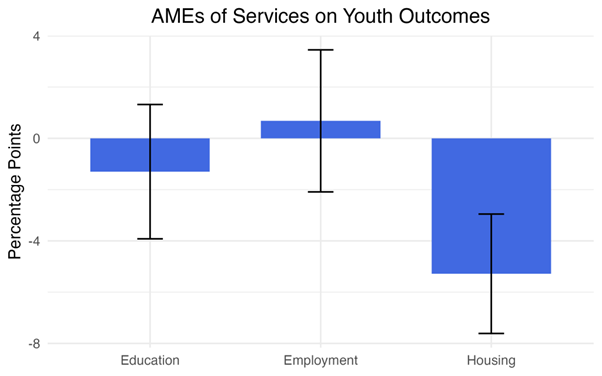
Overall, the results were discouraging. Most services showed little to no measurable impact on employment or school enrollment, and any differences were too small to be meaningful. Average effects clustered around zero, with housing outcomes trending negative for youth who received services, signaling that current supports may not be strong or durable enough.
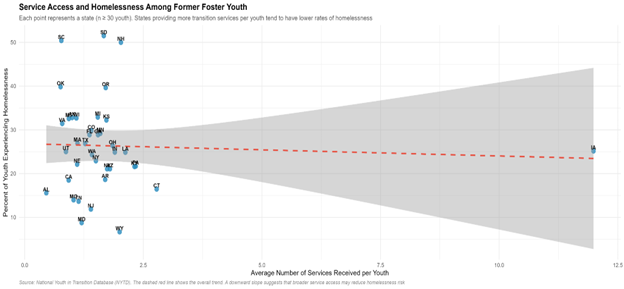
One service stood out: budgeting and financial management training. Youth who received this support were about six percentage points more likely to be employed at age 19, the only clear positive effect in the analysis. Housing outcomes were especially concerning. Youth who received services before age 19 were less likely to report stable housing at 19. This does not mean services caused housing instability, but it suggests broader service access alone is not enough to prevent homelessness.
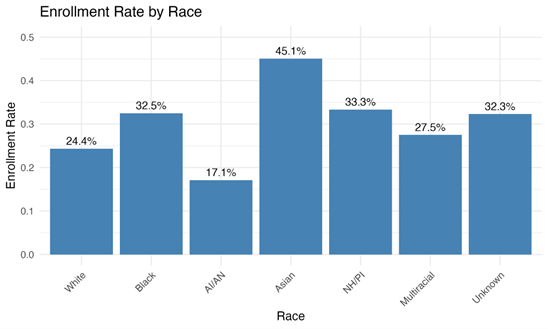
The data also revealed persistent racial disparities. Black youth and American Indian or Alaska Native youth were significantly less likely to be employed or stably housed than White youth, regardless of service receipt. Enrollment rates show uneven access to educational stability across groups, reinforcing the need for targeted, equity-focused supports.
The policy takeaway is clear: expanding one-size-fits-all services is unlikely to move outcomes. Instead, policymakers should prioritize targeted skill-building programs, especially financial management, employment readiness, and independent living supports. These are low-cost, scalable, and tied to the only service with a measurable payoff. If we want better outcomes for youth leaving foster care, we need to invest in what actually helps them build stable, independent lives.
Methodology
Which dataset(s) were used?
Data were drawn from Waves 2 and 3 of the National Youth in Transition Database merged with the Adoption and Foster Care Analysis and Reporting System, resulting in a sample of 8,464 youth observed at age 19 and a longitudinal subsample observed again at age 21 across multiple states. The dataset contains 61 variables on service receipt, demographics, foster care history, and outcomes. Service indicators include independent living skills training, budgeting and financial management, housing education, supervised independent living, rental assistance, and educational financial aid.
What is the time period for analysis?
The time period for analysis is years.
How was the data cleaned (filtering, sorting, grouping, etc.)?
The clean_names() function was used in the janitor package to standardize variable column names. The any_service variable was created to represent if youth received any 1 service out of all service variables, for analysis purposes (any_service is the service variables grouped together and coded 0/1 with 0/1 binary values). The employed_any variable was created to represent if youth had either full time or part time employment as an outcome, since these were originally two separate variables. The housed_19 variable was created to represent if youth were stably housed by mutating the homeless binary variable and only using “0” values (indicating youth was not homeless). For analysis purposes, outcomes (employed_any, enrolled_19, and housed_19) were converted to numeric data variables. The sex, race, and foster_status variables were converted to factors using factor() function for analysis purposes. Outcome variables and factors were also filtered to exclude “0” values for logistic regression analysis.
How were missing values handled?
11,569 duplicates were created during the data merge process that were then dropped from the dataset. 2,581 observations were dropped due to incompatibility with research question (no service records were available for these observations) NYTD/AFCARS nonresponse codes (2, 3, 77, 88, 99 - these were originally coded as “Not Applicable”, “Legitimately Skipped” or “No Response”) were converted to “N/A” for standardization since they were essentially missing values. Additionally, the main binary variables in the dataset were all recoded to 0/1 to drop invalid codes. The missingness in key outcome variables (homeless, employment indicators, educational enrollment, substance abuse, incarceration) is likely non-ignorable since youth experiencing homelessness, unemployment, or instability may be systematically harder to reach for follow-up surveys, creating potential bias in our estimates. The service exposure variables show minimal missingness (<0.2%), these are our primary independent variables. For data measuring and analysis purposes, the sample was restricted to complete cases while acknowledging potential selection bias.
What visuals were created?
The visuals created included box plots for average marginal effects (AMEs) by outcomes, bar charts showing enrollment rates by race, and state-level housing effects line plots for interaction models.
Is the analysis descriptive or causal?
This analysis is quasi-causal, because it uses a difference-in-differences (DiD) design to estimate the associations between receiving transition services before age 19 and outcomes at age 19. While DiD strengthens causal interpretation by comparing treated and untreated youth over time, the findings should still be interpreted cautiously due to limitations in the observational NYTD-AFCARS data, including nonrandom selection into services and coarse measurement of service intensity. Thus, the study provides evidence of estimated treatment effects under DiD assumptions, but the conclusions are not fully causal in the same way as a randomized experiment; instead, they represent credible but qualified causal estimates dependent on the validity of parallel trends and other DiD assumptions.
Recreate the Analysis
Download the Data & RMD
Use these files to reproduce the foster care analysis and figures.